
At the Business Software Alliance’s (BSA) TRANSFORM policy forum, leaders from government and industry underscored how the conversation around artificial intelligence (AI) is entering a new phase, with greater attention to the workforce, security, and policy frameworks needed to support adoption.
Across nearly four hours of programming, speakers from the US government, BSA, and its member companies and partners suggested that catalyzing AI skills growth and harnessing AI capabilities to further security will help to support the broad and successful adoption of this technology.
AI Across America: How Every Sector Wins
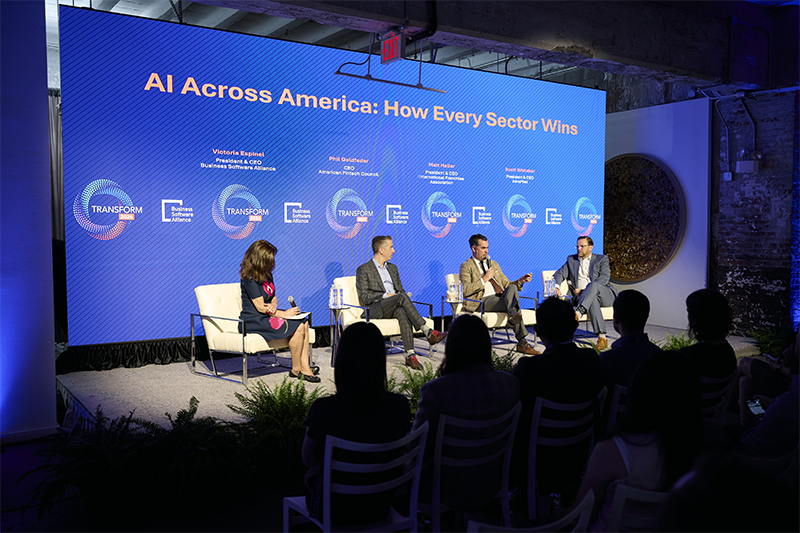
The event opened with a focus on how AI is empowering businesses across the American economy by creating opportunities across sectors, from financial services and healthcare to franchising and small business operations. BSA CEO Victoria Espinel hosted a cross-sector panel of industry leaders, featuring American Fintech Council CEO Phil Goldfeder, International Franchise Association President and CEO Matt Haller, and AdvaMed President and CEO Scott Whitaker.
“AI has been remarkably transformative in two ways,” said Whitaker. “The ability for our companies to use AI to improve patient health has been unbelievable, and the impact has been clear on the patient side, really more than anything else.”
Goldfeder noted that “what fintech did for financial services, AI can do for fintech,” creating new opportunities to expand access while improving safety and efficiency.
“With AI, we’ll be able to move more people into the ownership economy because the technology has democratized access to more information across the board,” said Haller, emphasizing the impact of AI on helping franchisees grow their businesses.
By providing first-hand accounts of AI’s impact across multiple parts of the economy, the panel helped inform subsequent programming at TRANSFORM.
Beyond the Headlines: Energy, Quantum, and What Comes Next
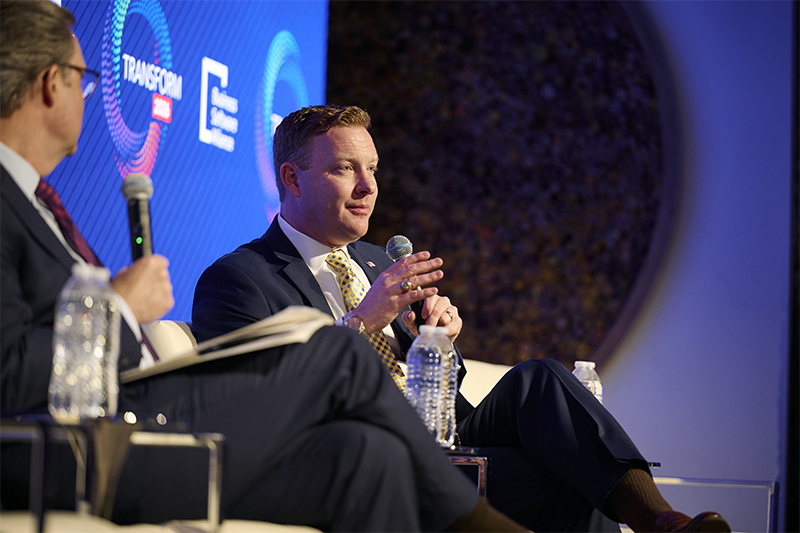
Next, Craig Albright, BSA Senior Vice President of US Government Relations, sat down with Conner Prochaska, Director of the Advanced Research Projects Agency-Energy at the US Department of Energy, to discuss the technologies shaping the next era of innovation.
The conversation reflected a broader shift in technology policy thinking, with AI, energy infrastructure, and quantum increasingly viewed as interconnected drivers of future competitiveness. Prochaska emphasized that policymakers and innovators need to think more across these technology domains, rather than treat them as separate policy challenges.
“AI is enabling technology. We’ve been working on quantum for decades in multiple labs across multiple sectors, and AI power can be applied to some of the quantum problems related to error correction or other challenges that exist in quantum computing, or quantum networking, or quantum sensing,” Prochaska said.
The discussion highlighted how advances in AI, energy, and quantum technologies are increasingly intertwined, requiring policymakers to think across technology domains to unlock future innovation and economic growth.
The Geopolitics of Innovation: Keeping America’s AI Edge
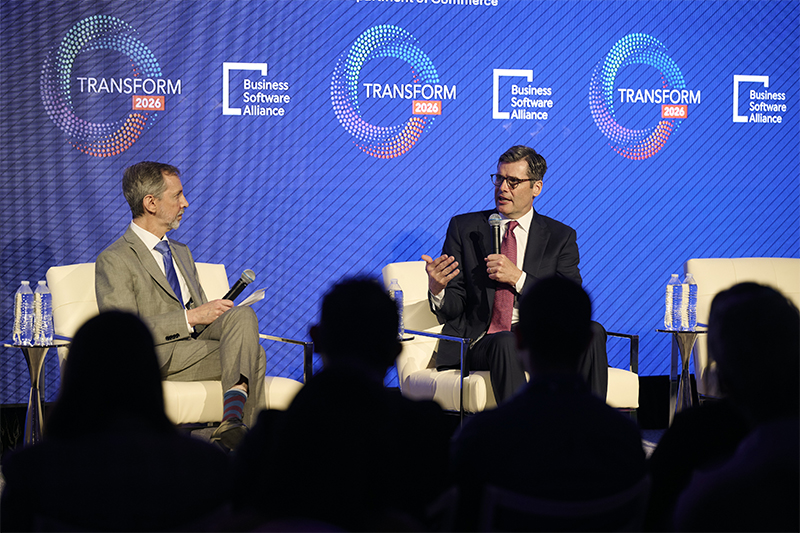
Aaron Cooper, BSA Senior Vice President of Global Policy, subsequently joined Bill Guidera, the Incoming Deputy Under Secretary for Innovation & Engagement at the US Department of Commerce, to discuss the policies needed to maintain America’s leadership in AI.
Guidera highlighted the American AI Exports Program and the importance of creating an environment that enables continued leadership in AI development and innovation.
“The innovation economy in the US is led, in many cases, by American companies,” Guidera said. “We want to do what we can to facilitate its growth, its emergence — our ongoing strength.”
From New Delhi to Geneva: Building the Next Chapter of Global AI Cooperation
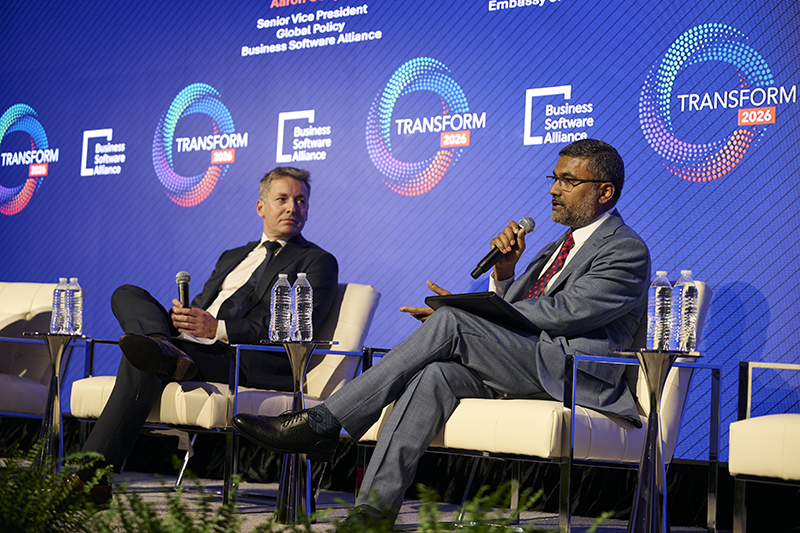
Following BSA’s engagement at the India AI Impact Summit 2026 and looking ahead to next year’s summit in Switzerland, leaders from both diplomatic missions to the United States reflected on the role of these convenings in the AI landscape.
“In India for our AI Summit, we have taken the AI conversation to a different level altogether,” said Dr. Ajay Kumar, Minister (Commerce) at the Embassy of India. “We have taken the application aspect to heart, seeing how AI application can change people’s lives and how these can be leveraged for sectors like education and healthcare.”
Adrian Hauri, Deputy Chief of Mission at the Embassy of Switzerland to the United States, expressed optimism that AI summits would become a springboard for more regular coordination among governments.
“Looking from the Swiss perspective, first of all, we hope there will be an outcome,” Hauri said of Switzerland’s ambitions for the summit. “We have now a series of summits, and instead of just creating a series of events, we really would like to see at the outset of the outcome formats, maybe work streams, maybe outcomes that can be reviewed at the next summit.”
BSA had an active presence at the India AI Impact Summit 2026, helping to launch a global AI adoption agenda among world and industry leaders gathered in Delhi.
The AI Policy Pipeline: States, Congress, and the Road Ahead
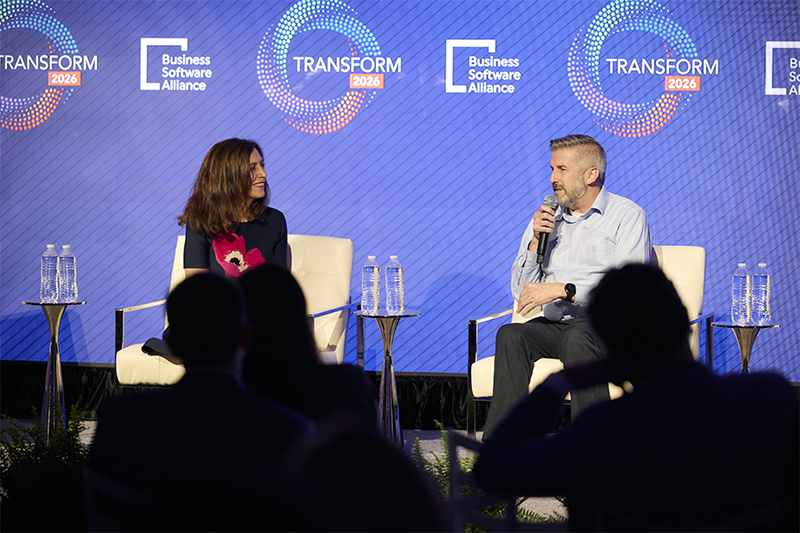
State Senator James Maroney (CT), Deputy Majority Leader of the Connecticut State Senate, joined Espinel onstage to talk about the latest in state policy. Maroney has been the informal leader of a working group of state lawmakers on AI policy, and Connecticut recently enacted updates to its privacy laws.
Maroney reflected on some of the things the Federal government can take on, while carving out space for state action. Further, he expects states to continue to take a leading role on consumer issues, with other work left to Washington.
“A lot of the bigger issues that we wouldn’t have resources for as a state — developing standards and frameworks — those are things that can be handled at the federal level,” he said.
From Classroom to Career: Preparing America’s AI & Cyber Talent Pipeline
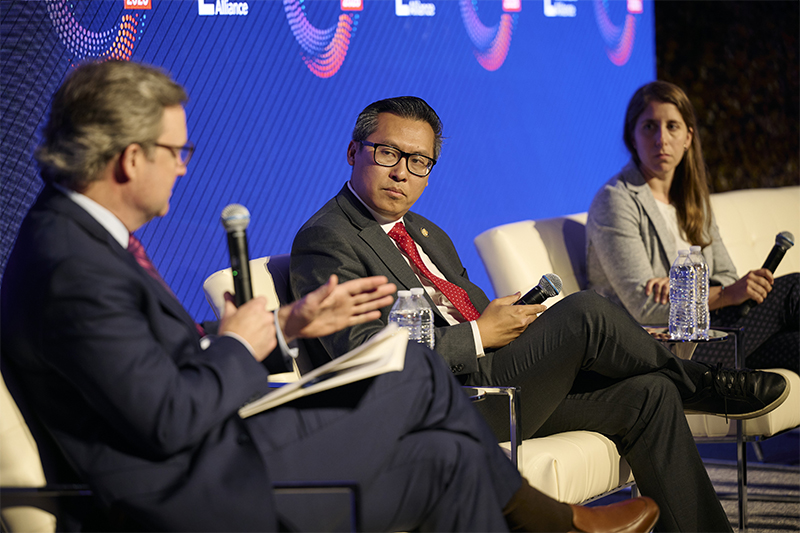
A recurring theme at TRANSFORM involved the growing demand for technical talent and AI skills, with speakers focused on how educational institutions, government, and industry can work together to prepare workers for AI- and cybersecurity-related careers.
Rep. Vince Fong (CA) said that workforce development related to AI remains an important area of bipartisan consensus.
“We’re trying to find a common ground on these bipartisan issues where we can say we all agree that AI is here, and we need to create a workforce, and how do we create those pathways into those careers?” Fong said. “We are facing real-world challenges, and we need to give our students real-world experience.”
Alyssa Chudnofsky, Executive Director for Workforce Partnerships & Strategic Engagement at the College Board, pointed to her organization’s soon-to-launch Advanced Placement (AP) Cybersecurity offering as an example of an initiative that provides both real-world skills and credentials for employers.
“The difference with these courses that we’re building — AP Cybersecurity, AP Networking, AP Business — is that we’re also aligning them to entry-level roles,” Chudnofsky said. “What competencies, what skills, what knowledge do you need to go into becoming an information security analyst, and doing those crosswalks of skills? Not just utilizing college competencies, but also looking at workforce skills and readiness too.”
Panelists emphasized the importance of building pathways that connect education, skills development, and workforce opportunities.
Cutting Through the Red Tape: Procurement Reform in the AI Era
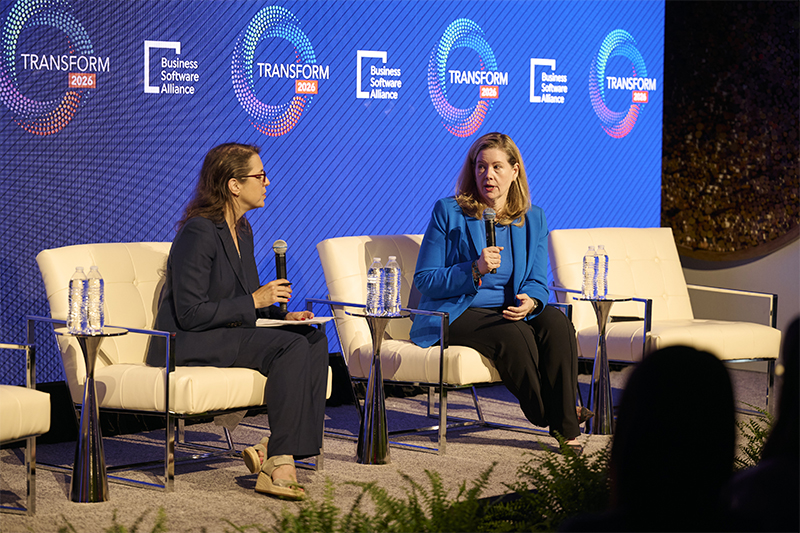
Emily Murphy, former Administrator of the US General Services Administration, joined Jessica Salmoiraghi, Senior Director for IT Modernization & Procurement at BSA, to discuss how procurement modernization can help governments adopt innovative technologies more effectively.
Whereas most contracts between software and AI providers and governments are standardized, it’s the last 20 percent of those agreements and integrations that can become most challenging, Murphy said. The solution? Using AI to directly address those challenges.
“That’s actually where AI provides a lot of opportunities,” she said. “Identifying where you could more quickly build or integrate between systems, rather than trying to take the old legacy systems out completely. Or, starting to use new technologies to build things, and then customize and evolve them more quickly.”
Government as Customer & Enabler: Enterprise AI Adoption Inside Federal Agencies
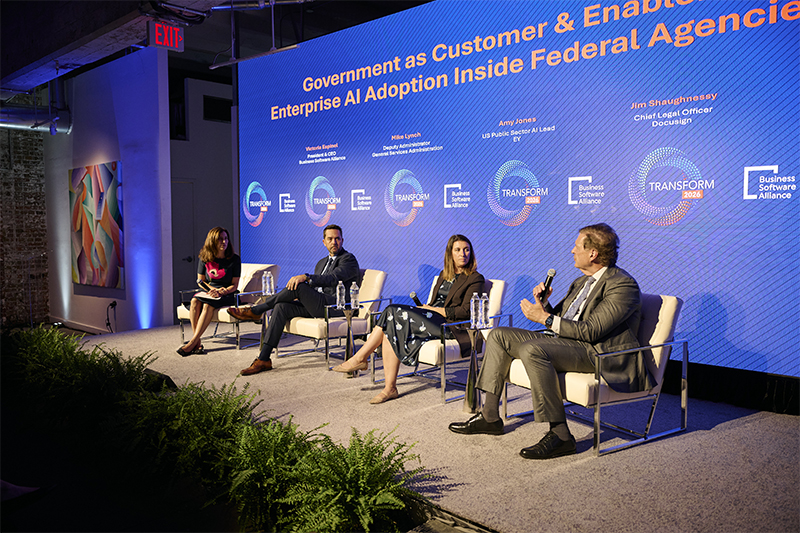
A panel featuring leaders in federal procurement and AI service providers highlighted the opportunities for streamlining government services.
“I do think it’s hopefully a year from now where we’re moving from having discussions about how many acquisitions happened, or how many deals we struck, or how many pilots have taken place, and really we’re getting into the broad-scale, enterprise use cases,” said Mike Lynch, Deputy Administrator of the US General Services Administration.
Docusign Chief Legal Officer Jim Shaughnessy, a member of BSA’s board of directors, highlighted the OneGov program in particular as a standout example of how enterprise software companies can provide better government services.
“There’s so much promise in the more effective delivery of services for citizens and more effective operational programs,” he said. “We just want to find a way to build this trusted infrastructure that will go to speed along everyone. If we can accomplish that in a year, I think the next five years are going to be unbelievable.”
Amy Jones, US Public Sector AI Lead at EY, offered some perspective on how companies engage with lower-risk pilot programs as part of their AI adoption journey as a step toward more meaningful engagement with technology.
“What we see at the most successful organizations is … a use case that can bring stakeholders to the table without scaring them,” Jones said. “But one of the reasons why that’s so important is because — if you pick something that’s not rights- or safety-impacting — you can generally start to get your CISO to talk the same language as your developers, to talk the same language as your lawyers.”
Defending the AI Economy: The Evolving Security Landscape
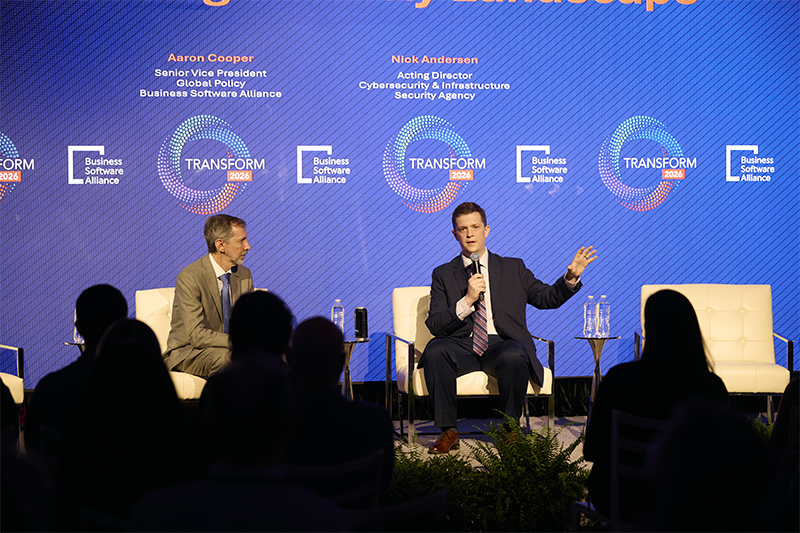
The importance of equipping critical infrastructure defenders with AI security tools was the focus of a conversation between Nick Andersen, Acting Director of the Cybersecurity and Infrastructure Security Agency (CISA), and BSA’s Aaron Cooper.
Andersen talked about the steps that CISA is taking to empower cybersecurity defenders first and foremost, with an eye toward embedding core AI skills into the agency’s workforce.
AI has “been something that we’ve continued to use as sort of an add-on in the recent past: How can this just make somebody a little bit more efficient, a little bit more effective at doing their job?” Andersen said. “That’s going to be core competency — table stakes — for us moving forward, somebody’s ability to be able to learn and take full advantage of those capabilities as a force multiplier.”
Skill the Federal Workforce for the AI Age
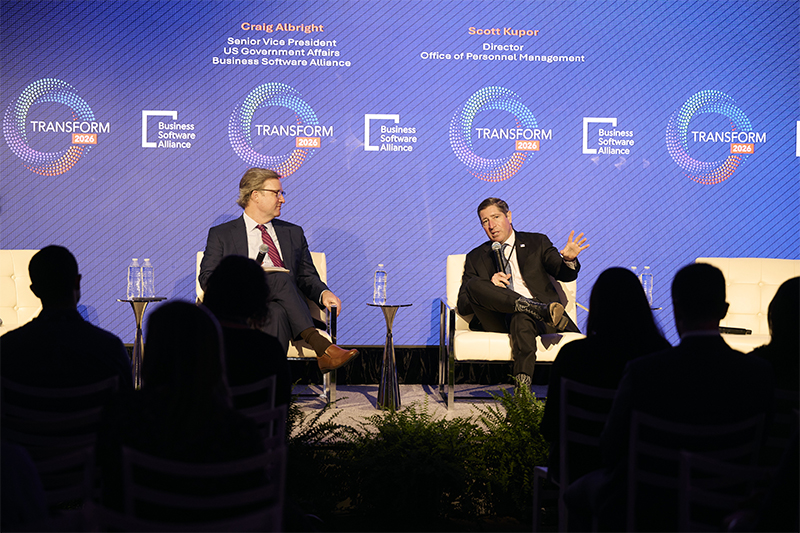
BSA’s Albright next joined Scott Kupor, Director of the Office of Personnel Management, to discuss how the government can prepare its workforce for an increasingly AI-enabled future.
Kupor highlighted the importance of workforce modernization, skills development, and ensuring federal employees have access to the tools and training needed to succeed.
“We need to find more ways to use technology to do more for the American people without bankrupting our kids and our grandkids,” Kupor said. “How can we deliver better customer service without having to go back to Congress every time and saying, ‘We need more headcount and portability’?”
BSA recently welcomed actions to add structure to the government’s approach to frontier AI security models to prioritize giving cyber defenders first access to these tools to harden defenses.
Writing the Rules of the AI Economy: Trade, Data, and Global Competitiveness
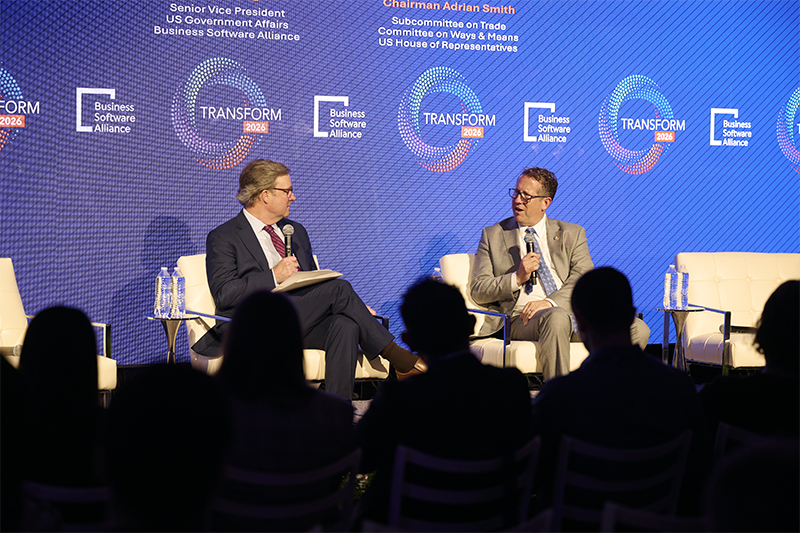
Rep. Adrian Smith (NE), Chairman of the House Ways & Means Subcommittee on Trade, then joined Albright in conversation to highlight the central role of digital trade in driving global growth.
“A lot of us are probably assuming that digital trade is really just about, say, [a few large companies],” Smith said. “But, as you know, it’s far broader than that, and it touches so many consumers … All across the economy, digital trade probably touches more people than just about anything else.”
The conversation was especially timely given upcoming opportunities to reaffirm best-in-class digital trade provisions as part of the United States-Mexico-Canada Agreement, which Smith said would be a continued focus for him and his committee.
Recognizing BSA’s Digital Diplomacy Champions
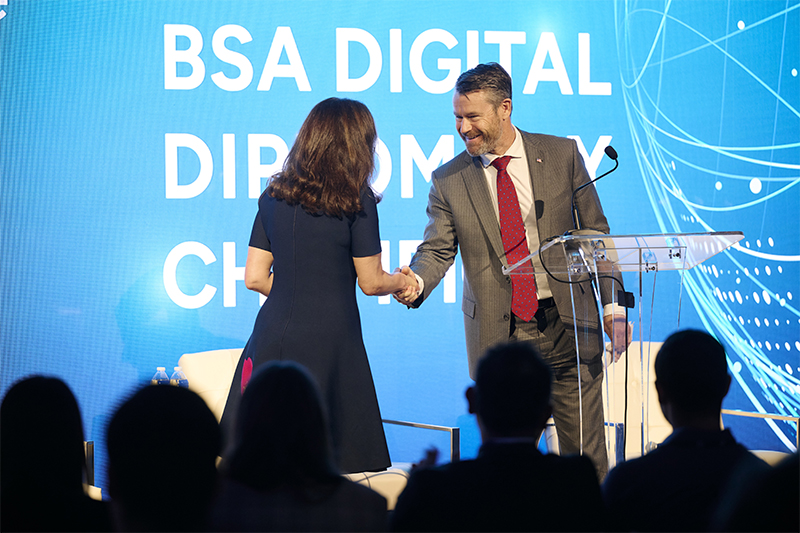
The event concluded with a short ceremony recognizing Sen. Todd Young (IN) as a BSA 2026 Digital Diplomacy Champion for his leadership and contributions to advancing policies that support innovation, international cooperation, and America’s long-term competitiveness.
“Senator Young has been at the center of the most consequential tech policy issues before the Senate. From his work on the bipartisan Senate AI Working Group, to authorship of the CHIPS Act, to his work to expand responsible digital trade, Senator Young, thank you for being a BSA Digital Diplomacy Champion,” said Espinel.
“It is a really important time for technology policy, and this is a defining moment for our country. This is no longer an era where we are waiting for tech to emerge. It is time for us to optimize our systems,” said Sen. Young.
Looking Ahead
The speakers throughout TRANSFORM emphasized the central role of AI in enabling security and growth across industries, and the need for setting the policy conditions to further AI-enabled growth for the US economy. Keep an eye out for more recap content from TRANSFORM in the weeks ahead.